The Different Types of Golf Clubs

Might it be said that you are a novice at the extraordinary round of golf? Then, at that point, permit us to acquaint you with the golf clubs. There are a few unique kinds of golf clubs in a regular golf player’s pack. As a matter of fact, today, there are five classifications of clubs: woods (counting the driver), irons, crossovers, wedges and putters.

What are these clubs? What are the characteristics of each sort of club, and its purposes?

The accompanying articles offer novices to golf an overall outline of the structure and capacity of each kind of golf club.

Meet the Woods

The classification of golf clubs called “woods” incorporates the driver and the fairway woods. (They are called woods despite the fact that their clubheads are not generally made of wood.) The forests are the clubs with the biggest heads (commonly empty, broadening a couple crawls from side-to-side and a couple creeps from front to back, with adjusted lines) and with the longest shafts. Golf players can swing them the quickest, and they are utilized for the longest shots, including strokes played from the teeing ground.

Meet the Irons

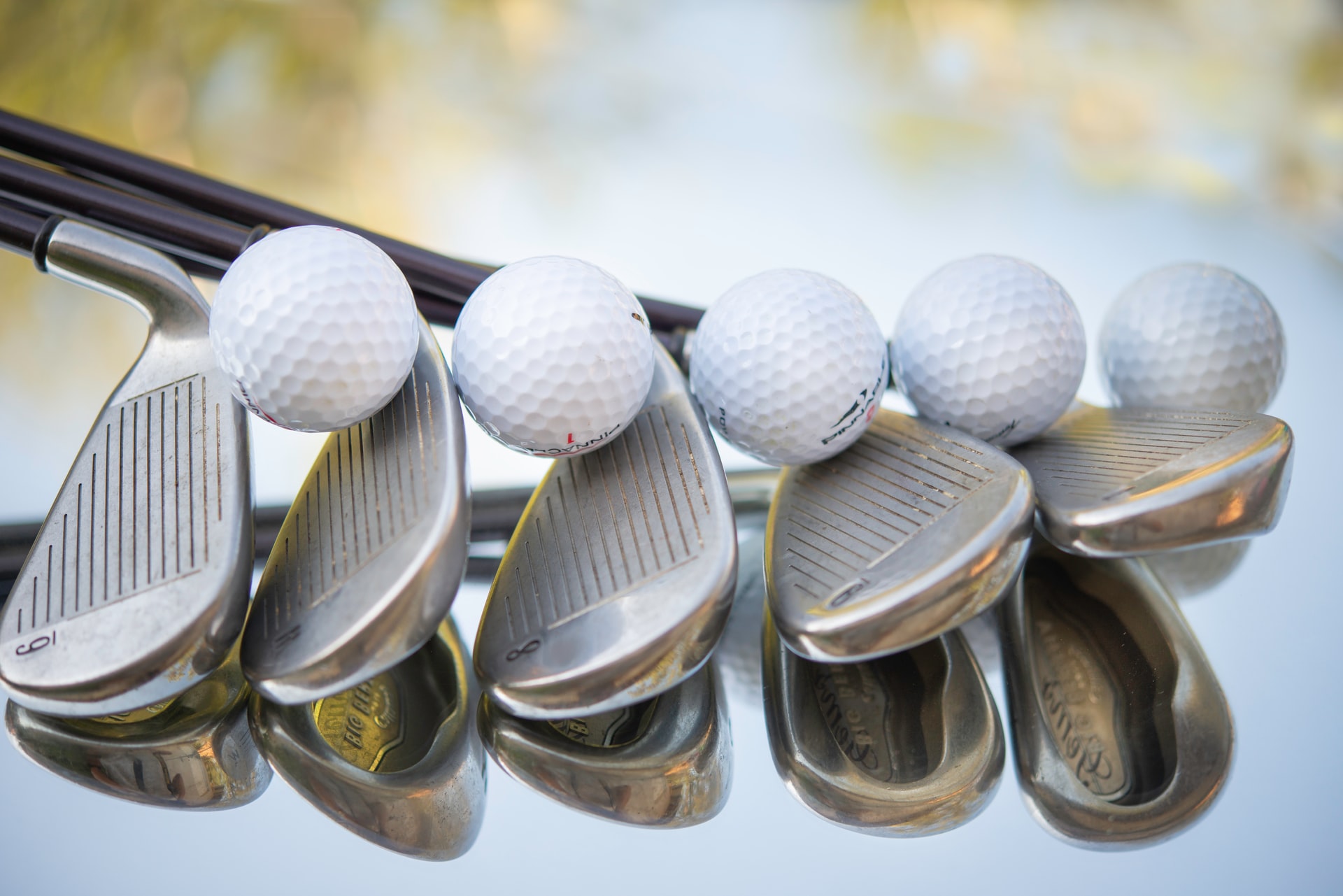
Irons come in numbered sets, generally going from 3-iron through 9-iron or pitching wedge. They have more modest clubheads than woods, particularly front to back where they are comparatively exceptionally slim (prompting one of their monikers: “cutting edges”). Most irons have strong heads, albeit some are empty. Irons have calculated faces (called “space”) carved with grooves that assist with holding the golf ball and grant turn. They are for the most part utilized on shots from the fairway, or for tee shots on short openings.

As the quantity of an iron goes up (5-iron, 6-iron, and so forth), the space increments while the length of the shaft diminishes.

Meet the Hybrids

Hybrid clubs are the most current classification of golf clubs. They became standard just around the turn of the 21st century, despite the fact that they existed for a long time preceding that. Consider the clubhead of a hybrid, a combination of a wood and an iron. Henceforth the name “Hybrid” (they are additionally now and again called utility clubs or salvage clubs). Hybrids are numbered as are irons (e.g., 2-crossover, 3-half breed, and so on), and the number relates to the iron they supplant. That is on the grounds that mixtures are thought of as “iron-substitution clubs,” implying that numerous golf players find them more straightforward to hit than the irons they supplant. Be that as it may, assuming a golf player utilizes cross breeds, it is undoubtedly a trade for the long irons (2-, 3-, 4-or 5-irons).

Meet the Wedges

The classification of wedges incorporates the pitching wedge, hole wedge, sand wedge and heave wedge. Wedges are their own kind of golf club, yet in addition are a sub-set of irons since they have similar clubheads as irons, simply more seriously plotted for more space. The wedges are the most noteworthy hurled golf clubs. They are utilized for more limited approach shots into greens, for chips and pitches around greens, and for working out of sand dugouts.

Meet the Putter

Putters are the most-particular golf clubs, and the sort of club that comes in the amplest assortments of shapes and sizes. Putters are utilized for, all things considered, putting. They are the clubs golf players use on the putting greens, for the keep going strokes played on a golf opening – for thumping the ball into the opening.

There are a greater number of assortments of putters available than some other clubs. That might be on the grounds that picking a putter is an exceptionally private cycle. There is no “correct” putter. There is just the putter that is ideal for you.

Putters commonly come in three styles of clubhead, and three assortments of lengths.

  • Clubheads: Clubheads can be a customary edge; a heel-toe clubhead; or a hammer clubhead. A conventional edge is thin and shallow, normally with the shaft entering at the heel (albeit in some cases screwed). Heel-toe putters have similar general shape as edges, however with additional load at the heel and toe to add edge weighting, and with other plan stunts to assist with making the clubs more “lenient” on mishits. Hammer putters have enormous clubheads that boost that absolution of unfortunate contact. Hammers arrive in an assortment of shapes and sizes, some exceptionally huge and very strange.
  • Lengths: Standard-length putters, regularly alluded to as “traditional putters,” range from around 32 to 36 inches long, from one finish to the next. Standard, or customary, length is the most famous and is the length that fledglings should begin with. Paunch putters are those whose length causes the grasp end to come up to – you got it – the golf player’s tummy. Also, long putters (a k a broomstick putters) are in the upper 40-inch, lower 50-inch range, permitting the golf player to stand more upstanding.
  • Character: But what putters reduce to is a private decision. In the event that it feels significantly better to you when you are utilizing a putter, that putter will most likely turn out great. Such a large amount of putting is certainty, so having a putter that feels quite a bit better, that requests to your eye, that you essentially like, must be something to be thankful for.

All putters, paying little heed to measure or shape, are intended to get the show on the road easily, with at least reverse-pivot to abstain from skipping or sliding. Practically everything putters in all actuality do have a limited quantity of space (commonly 3 or 4 degrees).

Names of Old Golf Clubs

Golf clubs have changed significantly over the long history of the game. There used to be clubs with names like mashie and niblick and jigger and spoon. What were those? Names’ meaning could be a little more obvious. We should go over the names of old, old golf clubs. For no reason in particular.


Potential Issues and Problems with Your Golf Gear

“A decent skilled worker never faults his apparatuses” is a well known saying in golf, yet not exact 100% of the time. Indeed, the golf player made the incorrect swing, yet maybe the clubs lead to that unpredictable, missed shot. In what capacity, you inquire? Here are the likely issues with your golf hardware.

1. Not feeling awesome

Incapable to make turns or control on wedge shots? There’s an opportunity your sections are frayed and endured. In the event that you play 40 adjusts yearly and practice routinely, you really want to change out your wedges each season or two.

2. Try not to get screwed

In the event that all around struck shots don’t feel strong, or your ball direction is low and blurring, your club shaft might be excessively solid. On the opposite finish of the range, assuming your shots will generally go excessively high or draw wildly, the shafts are probable excessively adaptable. Golf Digest examination shows that numerous golf players would profit from a lighter shaft, especially with regards to the driver.

3. Losing your balance

Some golf fitting organizations suggest changing spikes each 10 rounds. While that might be a bit unnecessary for the normal player, you ought to supplant your spikes something like once a late spring for ideal foothold.

4. Grandiose desires

A Golf Digest investigation of better golf players (0-12 impediment) found that 70% were utilizing some unacceptable space, with most analyzers requiring more space. What difference does that make? As indicated by a robot test by Golf Laboratories Inc., missing the right space on your driver by 1.5 degrees can cost the normal player 18 yards of distance.

5. Getting it together

A two dimensional issue with regards to holds. The first is fitting. A typical misguided judgment is that the size of your grasp is associated with hand size. Rather, your swing should direct your grasp estimation. The following issue includes mileage. As indicated by Golf Pride, grasps should be changed each 40 rounds or one time per year. Broken down holds can prompt unstable handles, causing mis-hits.

6. Figure out the wrinkles

Muscleback presses without a doubt have an excellent taste, and they offer greater usefulness for a ball’s shape and direction. Be that as it may, except if you’re playing on the PGA Tour, cutting edges are not so much for you. Assuming you’re battling with iron play, now is the right time to go to a seriously lenient club plan. Indeed, even high single-digit handicappers could profit from utilizing a game-improvement iron. Losing the cutting edges might go after your self image, yet it will likewise bring down your scores.

7. Going hybrid

Fear the long-iron shot? You’re in good company. On the off chance that you have a moderate-to-average swing speed, or are essentially wild with anything under a 4-iron, a utility club – on account of border weighting and thin sole – can fix your scattering and permit better digging on your shots.

8. Various strokes for various people

Putters are regularly picked due to feel. Albeit that is a significant part of the choice interaction, it’s not the sole component in the situation. Assuming that you feel like your stroke is unstable or produces askew hits, the snapshot of idleness benefits managed by the outrageous border weighting in a hammer style head could be for you. On the other hand, assuming you gloat an all the more free-wheeling way, the sharp edge has a place in your pack.

9. The next move up to you

While the most costly balls will more often than not be awesome, that doesn’t mean you essentially need to drop $50 for twelve rocks. From our ball discoveries: “Pay the most you can until you and your ability level quit seeing a distinction in execution. Be that as it may, it’s not only your debilitation. Reality is, assuming that you miss a ton of greens, you could require a costly, high-turning ball to help you get all over on a more regular basis. All things considered, don’t buy multi-facet balls with urethane covers until you can traverse a round without losing two sleeves. That is not ball-fitting, that is financial matters.”

10. Go to any (shaft) length

The rates change from club fitters, however many concur a huge piece of clients are playing shaft lengths mismatched for their swing. Assuming you feel like you’re excessively squatted or upstanding at address, or have a standard measure of diminished or lumped shots, there’s a decent opportunity the issue lies with your shaft length. A visit to your neighborhood master or club fitter will get you in the groove again.

An Overview: What is Golf

Golf is a men’s Olympic game where individual members or groups attempt to drive a little ball by hitting clubs into extraordinary openings. Significantly, the ball should be moved into the opening in less strokes.

History of the beginning and advancement of golf

 The specific date of golf isn’t known, yet it is accepted that it was concocted by Scottish shepherds who attempted to fold stones into dark holes with their staffs. While numerous antiquarians dissent, it is accepted that golf started in the Roman Empire and was played with twisted sticks and a ball loaded down with feathers. As per different hypotheses, golf showed up in China during the rule of the Ming line, as confirmed by a parchment portraying a head who is attempting to drive a ball into an opening with something like a club.

 Notwithstanding, present day golf comes from Scotland. The main notice of the game is the 1457 pronouncement of King James II of Scotland on the denial of golf, as it occupied bowmen from preparing. There were additionally designed rules and a framework with 18 holes on the field.

Rules of golf (momentarily)

This is what you want to do before you start the game:

1. Read the neighborhood rules of the game.

2. Put a recognizable proof of blemish ready. This is to guarantee that you can distinguish your ball among the others. On the off chance that the ball can’t be distinguished, it is viewed as lost.

3. Check the quantity of clubs, it is permitted to have something like 14 pieces.

The sport of golf begins from the beginning zone or as it is likewise called “tee” zones. It is so named on account of the T-molded stand on which the ball is set. Preferably, the player should initially hit the ball in the principle zone, then, at that point, in a couple of strokes to defeat it and send the ball to the region with the ideal grass (“green”). To fold the ball into the opening from the green, you want to utilize an exceptional stick – a putter.

Notwithstanding the standard guidelines, golf has rules of manners:

  • Stay away from the game until the gathering in front has gone to a protected distance.
  • Never postpone the game. Free the “putting green” when every one of the players in your gathering have passed the opening.
  • Avoid forward bunches that play quicker than you.
  • Reestablish the turf.
  • Level the tracks in the fortifications.
  • Try not to get on the other accomplice’s partying line .
  • Try not to put clubs on the putting green.
  • Embed the banner into place delicately.

Golf course

The golf course should meet various prerequisites, in particular a progression of openings, every one of the openings should have its own platform. There are two names on the platform that show the admissible limits of the zone to set the stake for the ball. Notwithstanding the platform on the field are available: a smooth field, lopsided field and different obstructions.

The last piece of the site is the opening, which for the comfort of direction is set apart with a banner. The opening is put on a site with a base stature of grass, which is classified as a “golf course.” In different regions, the tallness of the grass vacillates, this is done to make it challenging for players to pass the site. Generally speaking, the openings are situated in the view from the platform to the golf course. Yet, this isn’t generally the situation, in the event that the openings go amiss left or right, such openings are classified “left dongle” and “right homey” separately. Assuming that the bearing twists two times, the opening is classified as a “twofold pup.” The pitches consist of 18 holes, yet there are stages with 9 holes, in the present circumstance they pass two times, which is similar to 18 holes.